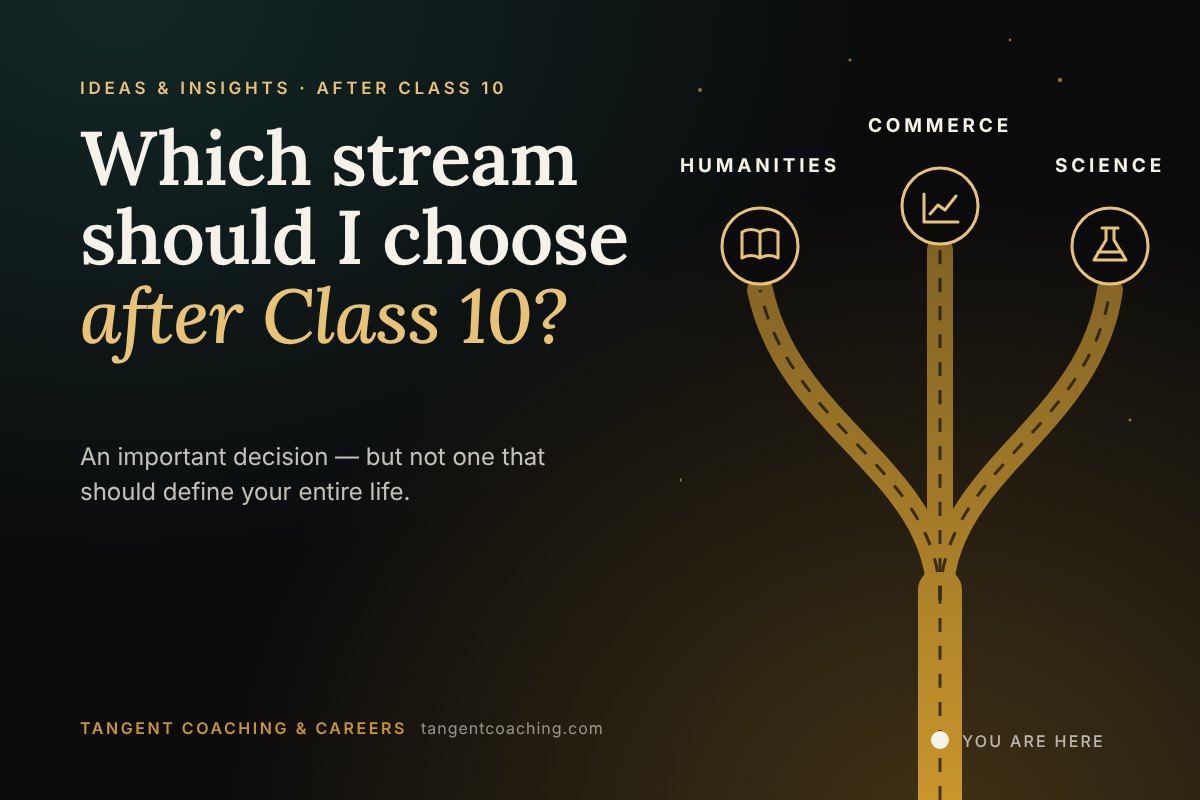
An important decision — but not one that should define your entire life.
It is one of the most frequently asked — and perhaps most anxiety-inducing — questions students face after Class 10:
“Which stream should I choose?”
For students, parents and families, it is a decision loaded with expectations, apprehensions and sometimes, considerable pressure. How does one decide which stream or subjects to opt for after Class 10?
In India, the choices are traditionally divided into three broad streams: Humanities, Commerce and Science. While students may have some flexibility in choosing subjects within these streams, certain subject combinations can significantly influence the courses and career options available to them later.
For instance, many professional courses require specific subjects at the Class 11 and 12 levels. Mathematics, Biology, Physics, Chemistry and other subjects may become prerequisites for particular undergraduate programmes. Not studying a subject at this stage may close certain doors — or make it considerably more difficult to pursue that pathway later.
This makes stream selection an important decision. But the question remains:
How does one make the right choice?
Is there a formula for choosing the right stream?
Unfortunately, there is no fixed criterion, prescribed pattern or mathematical algorithm that can determine the ideal combination of subjects for every student.
The decision involves several identifiable and measurable factors, as well as personal considerations that are not always easy to quantify. The starting point for most students is their performance in the Class 10 examinations. Marks provide some indication of academic aptitude, understanding and consistency. However, they can also be deceptive.
I remember an individual who scored less than 50% marks in Class 10 and subsequently went on to win a gold medal in M.Com. Academic performance at one particular stage does not necessarily determine a person’s future potential.
Marks matter — but they do not tell the entire story.
The many factors influencing career and stream selection
The choice of subjects is influenced by several factors, some practical and others deeply personal.
Practical considerations may include:
- Academic performance and subject-wise scores
- Availability of subjects and educational institutions
- Geographic location — whether one lives in a city, town or village
- The ability and willingness to relocate for education
- Financial constraints and affordability
- Previous exposure to work, activities or experiences
- Existing skills and competencies
- Career aspirations and long-term goals
Then there are the more personal dimensions:
- Interests and curiosity
- Aptitude and natural abilities
- Passion and motivation
- Personality traits
- Family expectations
- Individual values and aspirations
All these factors have a bearing on the eventual choice of subjects and, consequently, the career pathways a student may explore.
Can psychometric tests help?
Interests, abilities, personality traits and aptitudes are often considered difficult to measure objectively. However, psychometric assessments can offer valuable insights into many of these dimensions. Well-designed assessments can help students understand their interests, strengths, personality characteristics and potential areas of suitability. They can also help uncover possibilities that students may never have considered.
Career counselling, supported by psychometric assessments and meaningful conversations, can help bring greater clarity to the process.
The objective is not to allow a test to dictate a student’s future. Rather, it is to use the results as one of several tools to facilitate a more informed decision.
Sometimes, the most valuable outcome of career counselling is discovering an option that was never part of the student’s original plan.
Is stream selection the final destination?
Definitely not!
Education and careers are rarely linear journeys. People change direction, discover new interests, acquire new skills and explore opportunities that may not have existed when they first made their educational choices.
An MBA, for instance, can be pursued by graduates from diverse academic backgrounds, subject to the eligibility requirements of the institution and programme. Similarly, the UPSC Civil Services Examination does not restrict candidates to a particular undergraduate stream.
I have also witnessed remarkable examples of individuals who have traversed seemingly unrelated academic and professional pathways.
My sister completed her Bachelor’s degree in Science with Biology, without Mathematics, and went on to become one of the youngest Chartered Accountants in India at the age of 22, while also completing a Law degree.
And then there is another extraordinary young woman who began her journey in Medicine at Cambridge University in the UK, went on to become a Chartered Accountant of England and Wales, and subsequently completed a Master’s degree in Creative Writing from Harvard University in the USA.
Such journeys remind us that education need not be confined to rigid compartments. Curiosity, determination, the willingness to learn and the courage to explore can create pathways that may initially appear unconventional.
Choose wisely — but don’t forget to live!
Yes, choose your subjects thoughtfully. Understand the implications of your choices. Seek guidance. Explore possibilities. Work hard and remain committed.
But do not allow structured education to consume every aspect of your life.
Do not abandon your hobbies, games, friendships, interests or the simple joys of being young. Maintain a healthy balance between studies and relaxation. Learn to manage stress rather than allow it to overpower you.
Education should expand your horizons — not shrink your world.
Your stream is a starting point, not a permanent label. Your subjects are tools, not limitations. And your career is a journey, not a predetermined destination.
Your career does not define who you will become.
You define what your career will become.
— CMA (Dr.) Charu N Thakur
UNSURE WHICH STREAM FITS?
A psychometric assessment and a one-to-one counselling session can help you and your parents decide with clarity.
Explore career counselling →